
Like his last story on the site (“The People Who Live Inside”), “Bad Samaritans” spotlights Sozdinler’s ability to capture small town America and (some of) the people who call it home. Every character, every car, every street in town, every silo and every Applebee’s feels so distinct, so familiar, so real. But maybe my favorite aspect of this story (and “The People Who Live Inside,” and many others as well) is how powerfully and effectively Sozdinler is able to portray and mix sadness and humor. These characters meet at a grief group at Applebee’s, a kinda silly setting for such meetings, but the characters know that, too; sometimes (often!) silliness is needed in the face of grief. This story so effectively captures this mix of emotions, all while being legitimately funny on the page and just a joy to read. I hope you find it as much of a joy as I do!
—Aaron Burch
Editor, Short Story, Long
“Bad Samaritans”
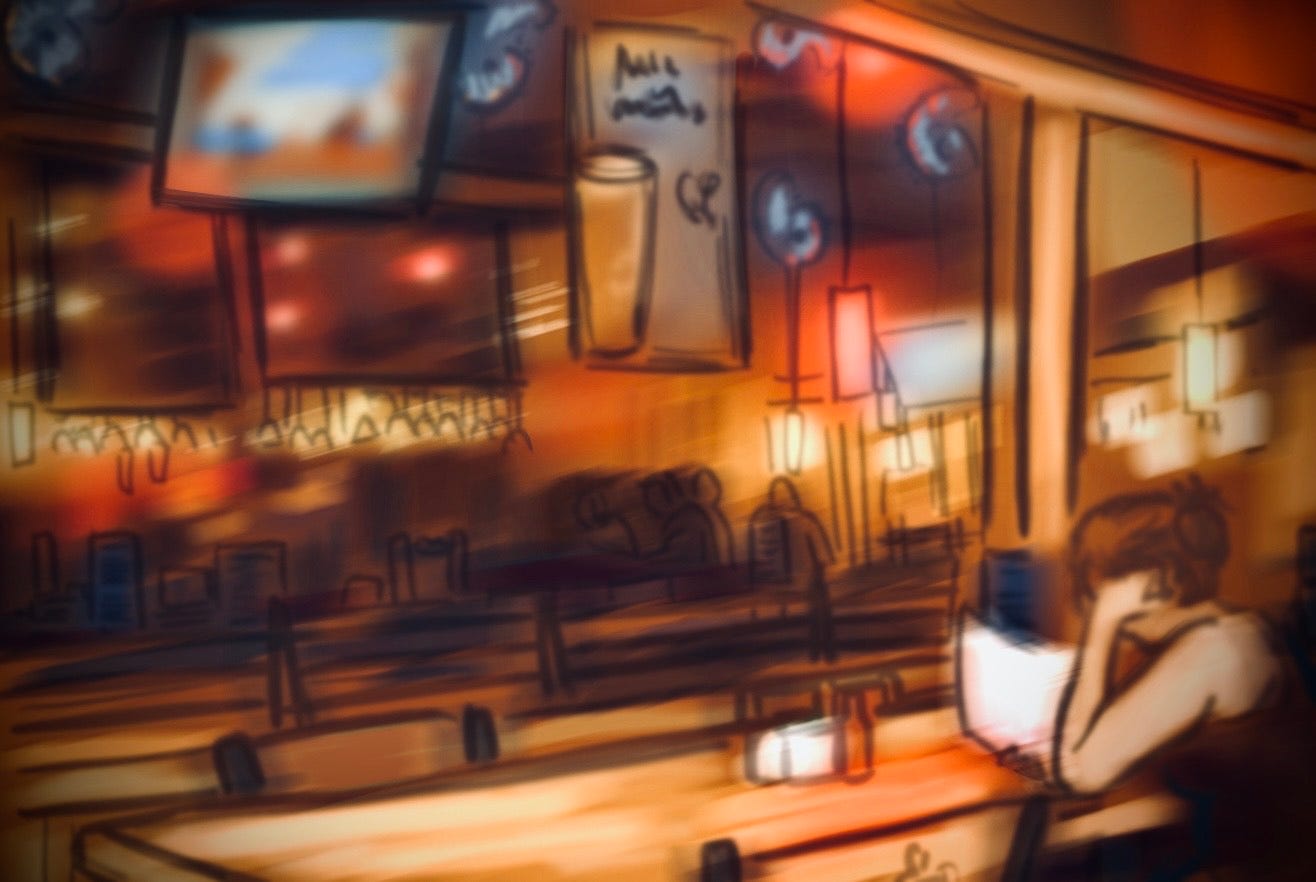
The first time I saw her, she was fanning herself with a laminated drink menu at one of the high tables in Applebee’s. I had only come because a flyer on the library wall announced that a grief counseling session would take place at this address, and I guess I didn’t have anything better to do. I was lonely enough to not care about the specifics. When I walked in, several 6-shaped balloons from an earlier birthday party were still floating around the restaurant, making it look as if someone had just turned 666666. A teenaged waitress was cleaning a table while a group of six sat in a half-circle around her under a television playing an NBA game on mute. There weren’t any other patrons around.
The woman with the drink menu was the first who noticed me. “If you’re here for crochet, that’s next door,” she said, without looking at me. I told her I was here because my mother died last winter and I saw the flyer for the support group. She stopped fanning and looked me over from head to toe. “Denise,” she said, nodding. “I heard they’d give us half-price mozzarella sticks if we order enough drinks.” She tapped the empty chair beside her. “Sit.”
I said thanks and then took the chair opposite hers. “Why are you here?”
Denise blurted a laugh. “You mean why am I here in particular or why are any of us here, in this life, on this planet?”
I shrugged.
“Well, if you must know,” she said, placing the menu back on the table, “my husband exploded just last September.”
Now it was my turn to laugh. I first thought it was a joke, but I realized my mistake when she didn’t laugh back. I apologized for my behavior. She watched others entering through the front door one by one, sparing me from further humiliation. They all kissed and hugged and welcomed each other with platitudes. They were a haggard bunch, separated by loss and united by grief. We all took seats around our table. I avoided Denise’s eyes the whole time.
Everyone introduced themselves one by one, including Denise. She said she was recently widowed and that her husband had not exploded in the figurative sense, like from anger or pressure or a midlife crisis, but literally, at the fireworks warehouse outside Beckley where he worked summers for extra money. She recounted all this plainly and calmly, as if she were telling us about her day. The group leader, whose name was Marianne and who wore a headset microphone even though there wasn’t any amplification system about, kept trying to steer us toward what she called “the processing language,” but Denise would not be steered. She said all support groups she’d been in were way too invested in healing and not interested enough in facts.
“The fact is,” she said, dipping a mozzarella stick in ranch, “parts of Tony were later found on a forklift. The one he’d operated for more than a decade. He’d named it after me. I find that really romantic.” Everybody got real quiet after that. Then Marianne thanked her for sharing her story and asked if anyone wanted to continue. An old man in suspenders across from her pointed at the TV and asked if we could turn on the volume. That was the kind of meeting it was.
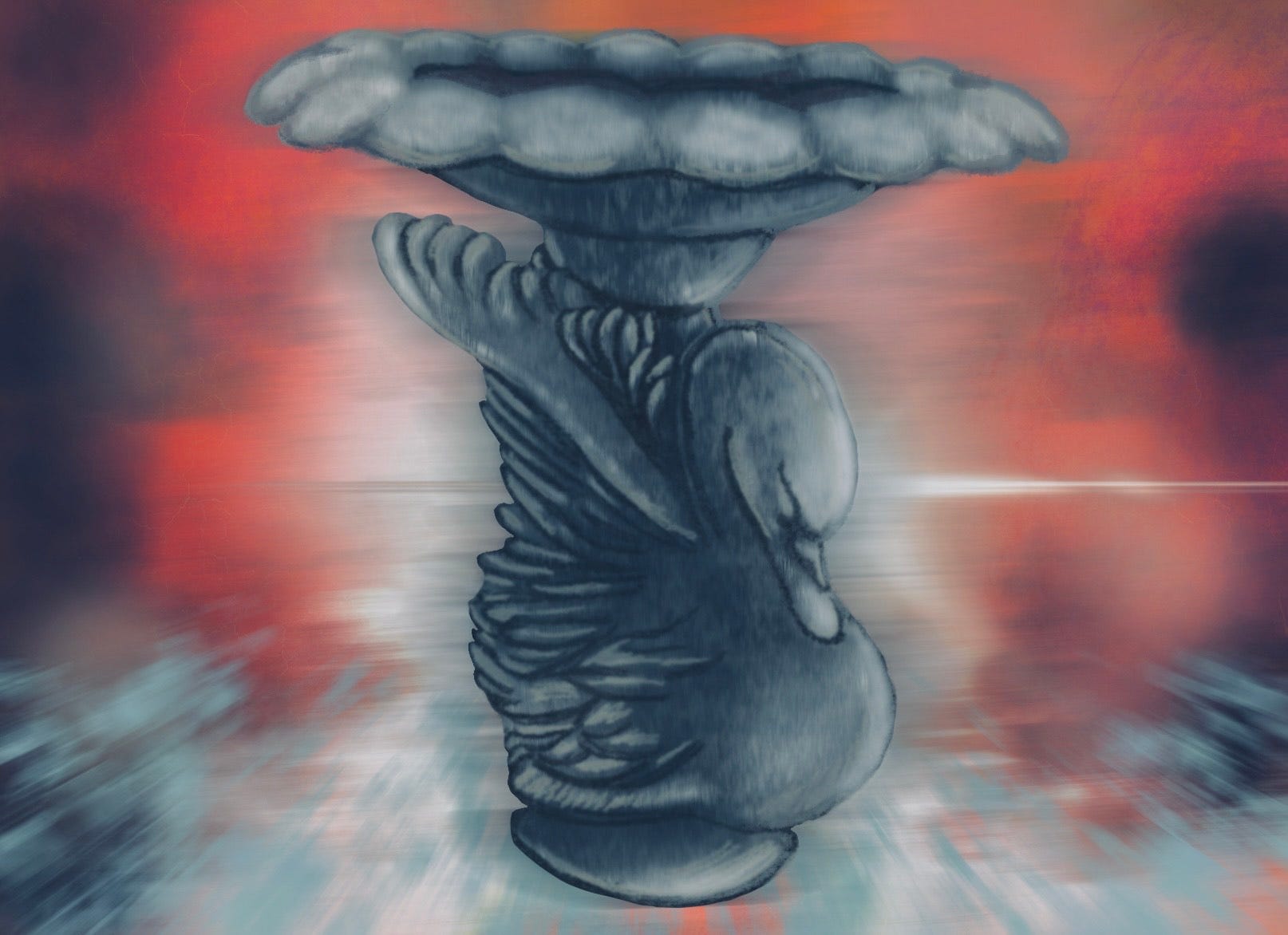
Afterward, Denise and I stood outside by the backdoor, rubbing our hands by the cigarette ashtray shaped like a black iron tulip. Her car was still running on the parking lot because, according to her, the battery was bad and if she turned it off, she feared that she might not be able to use the “old pecker” ever again. I told her I was sorry about her husband. She said thank you and asked what happened to my mother. I told her she slipped on ice carrying in groceries and hit her head on the neighbor’s birdbath. I said we buried her up in the mountains, next to Dad, to honor her will. “This might be the most Appalachian thing I’ve heard,” she said, then offered me a cigarette. Partly because I still was in grief and partly because I am terrible at saying no, I accepted it, although I don’t really smoke.
I started going to the grief group every Thursday whether I felt particularly bereaved that day or not. Sometimes Denise was there first, saving me a seat. Sometimes she texted me beforehand and said things like, “We shouldn’t let Marianne get away with breathing exercises tonight” or “God knows if she says ‘transcendence’ one more time, I’ll drive my car into the river.” Once she texted me “We ride at dawn” in the middle of the night, and when I asked what she meant by that, she said she would pick me up from my house in an hour and that I better get my ass up soon. When we got to the Applebee’s she ordered a bourbon burger and some truffle fries although it was early in the day. I ordered the club sandwich. I realized that dealing with grief at Applebee’s had less to do with mourning than watching other mourners eat. There was a strange comfort in witnessing others go through regular motions. There was Denise talking about Tony’s boot that was later found in a tree. There was the old man in suspenders who came back every week to discuss his dead beagle and to flirt with the waitress. And there was Marianne with her dry-erase board that had the line Feelings are overrated scrawled on it all the time, though for most of us in the group, feelings were the only thing that we could trust and hold onto.
One Friday evening, Denise skipped a session. I looked up every time the front door opened. I expected her to come in half-angry, half-cheerful, carrying some chaotic weather around her like always. Marianne had given it a few minutes but then commenced the meeting. She said tonight’s theme was resilience, which made me instantly want to leave. Halfway through, just after a newbie young woman started talking about her sister’s ghost, my phone buzzed. It was Denise.
In county jail, the message read. Long story. Don’t let Marianne know.
I read her text twice to make sure I wasn’t making it up. I grabbed my jacket and excused myself from the meeting at the expense of drawing glances from everyone, including Marianne. I hopped in the car and drove uptown. It was one of those small county facilities that was whiter than everything around it and looked ephemeral even in concrete, like the kind of in-between place where angels stop by before taking their souls elsewhere.
When I gave Denise’s name at the entrance, a deputy with walrus mustache said I only have ten minutes and led me down the hall to the visiting room. Soon, Denise appeared behind the glass in an orange shirt and looked more annoyed than ashamed. As soon as I picked up the walled-in phone, she said, “What the hell are you doing here?”
“I should be asking you the same.”
She shrugged and looked about for a moment. Then she leaned toward the glass partition and said, “I stole a helium tank from Party City.”
I couldn’t stop nodding, waiting for an explanation.
“For the balloons,” she added.
“What balloons?” I asked.
She looked at me like I was the dumbest man in the state.
“Tony’s memorial party, dumbass,” she said, and I couldn’t be sure for a moment if this was something we’d already discussed. “I was just trying to do something special for him.”
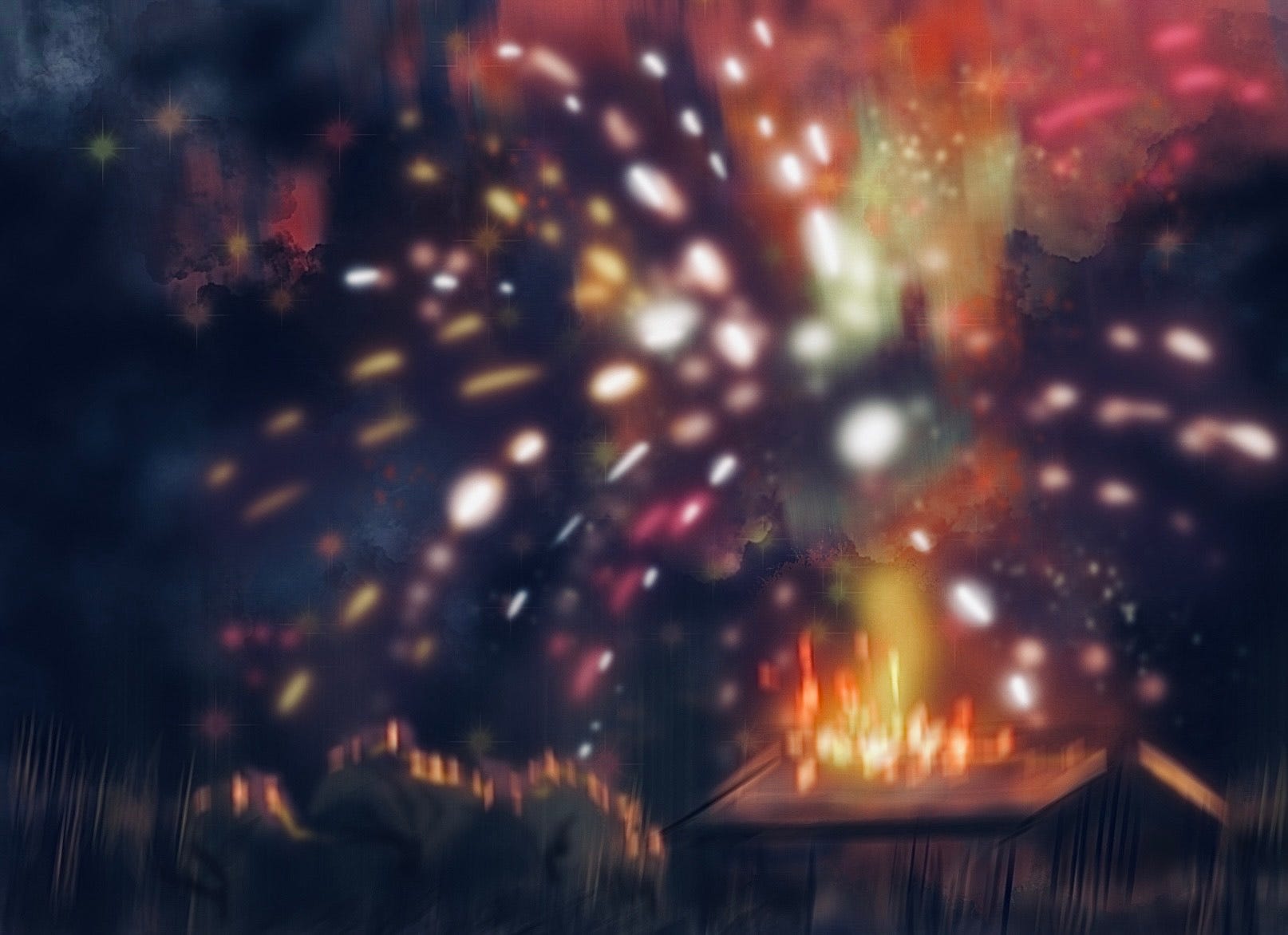
It turned out Denise had decided to honor her husband’s untimely death with an untimely ceremony and had purchased three hundred blue balloons on a whim and as many bespoke ribbons that read fly high tony, though she later admitted the phrase made him sound like a dead basketball player or a retired falcon. The helium, however, had become a problem. Party City had refused to rent her a second tank because, according to the manager, she looked “emotionally unstable,” and according to the state laws he had to report the situation to the authorities. Denise took issue with this and attempted what she called a self-checkout justice, the particulars of which I refrained from asking. There had been some kicking and pushing about. There had been some foul language involved. There had been, somehow, three hundred balloons involved.
I asked if she needed bail.
She said, “I need you to go to my house and feed my sister’s Pomeranian.”
“Your sister has a Pomeranian?” I was somehow more taken aback by this than the whole helium thing. “What’s her name?”
“Not relevant,” she said and got up from her chair. “The keys are under the big vase.”
I went over to her house and had some difficulty spotting the right vase. The front door opened to a series of barks. The little thing seemed full of hate toward bi-pedaled mammals and I couldn’t decide if she actually wanted to bite me or was just asking for attention. I took the corner chair and soothed the dog with little pets. I fed her the star-shaped kibbles standing on the counter. On the kitchen table were the corpses of three hundred deflated balloons and a printed photo of Tony wearing sunglasses and holding a fish by the mouth. I read the handwriting under the photo: I hope heaven can handle you, handsome. I stood there looking at all that undecided air in the kitchen and for some reason I nearly came to tears. The last few months proved to me that grief can be a little bitch that makes me do unexpected things at unexpected times. Some days, I hardly ever cracked and some days all it took was some ribbons and tanks and a friend in jail and a fish photo and a hateful little dog licking her own tail under the table.
When Denise got out two days later, she called and asked if I wanted to get some coffee. She picked me up half an hour later. We drove to the nearest Applebee’s and sat in her car eating chicken burgers. When she was done eating, she tried to explain to me the criminal justice system in West Virginia in dubious terms. She said she’d recently started considering giving up on the whole balloon release idea because, according to an online environmental forum she’d read in jail, balloons were practically trash for the sky. “I just wanted one thing to go up in my life instead of down, you know,” she said, and I understood what she meant right away. God knows my mother had gone down fast. Down on the ice. Down into the ambulance. Down beneath the earth while the preacher claimed she had risen to somewhere better. All before I could even get up from bed and drive over to the hospital. All before I could face all that somber music.
So I told Denise we didn’t need balloons to honor Tony. We could do something else.
“Like what?” she said.
“I don’t know.” I shrugged. “Like, give his name to a forest or a panda or something.”
She shook her head, a little smear of ranch sauce wobbling on her lips. “You are fucking unbelievable.”
Afterward, we drove out to the fireworks warehouse where Tony had worked for over a decade and died by explosion. It looked mostly abandoned these days. There were just a scorched slab and some chain-link fence and some winter weeds sprouting about. You wouldn’t be able to tell someone had exploded there over the last year. Denise had brought Tony’s sunglasses, the fish photo, and a six-pack of Dr Pepper, Tony’s favorite beverage. We stood there looking at the trees behind the warehouse swaying with the wind. Convoys of motorbikes passed somewhere beyond the hill and we were left with the ghosts of their rumbling.
Denise set Tony’s sunglasses on the floor and leaned his photo against it. She opened two cans of Dr Pepper. We drank one and poured one out to honor Tony. At one point the wind rattled the photo and slammed Tony face-down into a nearby mud puddle. Denise screamed, “For Christ’s sake,” but then for some reason she burst into laughter.
Then, thanks to some sick cosmic joke, we saw a red Subaru pulling up onto the factory parking lot. The nearer the car got, the more and more Marianne’s stubby, permed figure crystallized behind the wheel.
“What the fuck.” Denise looked at me in an accusatory way like I was the one who arranged all this. I shrugged and watched Marianne struggling to parallel park by the entrance. The car lurched to a stop then coughed to silence, like an old man on his deathbed. She got out of the car in her fleece vest and rainbow-colored sneakers. Denise was the first to speak.
“How did you know we’d be here?”
Marianne peered down at the sunglasses and the soda and the wet fish photo and pressed both hands to her chest in an affectionate way. “This is actually quite sweet, you know.”
Denise stared at her like she was still demanding an answer.
“Fine, it was the deputy who called me, okay?” Marianne threw her hands in the air. “They knew you wouldn’t let this go.” She asked Denise if there was a way to make her change her mind. She asked if we could perhaps incorporate Tony more into our sessions from then on. Denise listened and listened, without moving a muscle. There was a lingering, awkward silence. Every time I figured someone would finally say something the silence pursued only longer, and at some point I pictured us through the eyes of a passerby biker, the three of us standing on a nondescript parking lot and locked in a standoff like some lousy cowboys in a spaghetti flick.
“I understand,” Marianne then said, and turned around silently. She walked back to her car while the wind kept knocking Tony’s picture over. “You guys know where to find me if you change your mind.”
The minute her car was gone Denise sat on the floor and started crying. Like, real crying. Hard and ugly. I sat beside her and watched the cars dance around us like bees. After a while she put her head on my shoulder and said, “I really miss that idiot.”
“I know,” I said, then after a moment of silence, added, “Did you know my mother hated Applebee’s? Like, really hated it.”
Denise lifted her head and planted a kiss on my lips. And then another, and another, until our tongues got involved like the Pomeranian’s waggy little tail. Her mouth tasted like dead chicken and salt. I didn’t want our kiss to end, confident that I could keep sucking the traces of grease on her lips into eternity, rinse the grief out of her breath.
But she soon pulled away and gave me a look that was half panic, half apology. She held my hand. “Let’s go back,” she said. “We got a furry little asshole that needs to be fed.”
These days, when people ask how we met, I start with telling them the truth. I say I met Denise at a grief counseling group in the back of an Applebee’s under a muted basketball game. I say her husband had exploded and my mother had fallen beside a swan-shaped birdbath and somehow this seemed enough for both of us to get to know each other. People usually don’t know what to do with that kind of story. They laugh a little and then apologize for their reaction, like I once did, or they simply choose to look away. But the truth is, that’s how life is most of the time. It begins in one kind of hole and, if you are lucky and not like Tony, ends in another. In between, there’s a lot of driving around and doing stupid stuff to deal with all that, like going to jail or detonating three hundred balloons in an exploded person’s memory. And then one day you look over and the other person is still there, holding a laminated menu at you like a gun in an Applebee’s, and you think, against all evidence, maybe I can live with this.
STORY:
Sarp Sozdinler is a writer based between Philadelphia and Amsterdam. His work has appeared in Kenyon Review, Electric Literature, Wigleaf, HAD, Hobart, X-R-A-Y, Burial, The Forge, Flash Frog, Pithead Chapel, Maudlin House, and elsewhere. He serves as the editor of The Bulb Region.
*
ART:
Everin Casey is a multimedia freelance artist and theatrical scenic painter from the Florida/Georgia line currently working in New York City. Their work can be found in various households, galleries, and theaters from coast to coast or on Instagram at @everrinart._

Next Tuesday, we’ll feature a bonus interview with Sarp about this story.
Like a big hug💙🪽💋🕶️
What a wonderful story. Warm, sad, funny, hopeful.